The Angkor Air flight from Saigon brought us to Siem Reap at dusk,a resort town in northwestern Cambodia and the gateway to the ruins of Angkor.Visa on arrival was a cake walk even though our photos were locked up safely in the checked in bag.For a few dollah more they do the needful,stamp your Visa and let you in.
Hotel's emissary accorded us safe passage and soon we were discussing our itinerary with the Van driver and requested him to get us a guide for local sightseeing in the morning.We were doing this leg of our journey without the aid of a professional tour organisor.
Day 1
We are heading to the Dock.. a ride of about 45 minutes to take a boat ride to see Kampung Fluc fishing village this morning.Kompong Phluk is a relatively small village that provides very good insight into the village lifestyle within the Tonle Sap lake.
This lake is the largest fresh water lake in S-E Asia.It stretches over a length of 120 km and is connected to the Mekong river.The relaxing chug-chug of the diesel junk keeps us glued to the waters ahead.We start seeing houses,school,place of worship all on stilts almost 10 meters high.Right now the water level is very low,the dry season when the water from the lake is flowing into the river ahead.But in the wet season the swollen Mekong will reverse the
flow,flooding the lake and the plains.No wonder such high stilts are required.
|
A Panorama
 This village exists almost exclusively on fishing and related activities.and the village is surrounded by flooded mangroves.. and it is home to a variety of wildlife including crab-eating macaques.

Leaving the fishing village behind we made our way to the main body of the lake.It was massive.The scenes were reminiscent of Vembanad lake in Kumarakom,Kerala.The guide explained all about the lake and soon we were setting our course for the return.All the couples took their turn in acting out the young lovers pose on the Prow and singing "My Heart will go on"...aka Titanic theme song.
|

We had excellent lunch in the city with lots of coconut water which was soothing.
 Our afternoon started with a visit to a silk farm.The weather was at a manageable 30-32 C but it was stuffy.We had a great demo tour learning all about silk...from the mulberry tree orchards, silkworm breeding,the spinning mills to the dyeing and weaving processes all done very traditionally.Silk threads are produced by highly skilled ladies who work hard to create beautiful silk fabrics.And there was a gift shop too for the ladies to indulge.
Amazing fact! did you know that one small Cocoon like the ones on this picture could give birth to about 300 meters of silk threads?Unbelievable,isn’t it?
A taste of culture and the arts in every new country should always form a part of the itinerary. To be able to understand its people,it is essential that one's culture be studied and understood.As for Cambodia, the Khmer culture is depicted by the performance of the beautiful Apsara dancers.Apsara,for those of you who want to know, is a female spirit of the clouds and waters in Hindu and Buddhist mythology,youthful and elegant and superb in the art of dancing.

We were taken to Koulen restaurant located in the heart of the city for the show and dinner.The restaurant is huge and caters to 650 if all seats are taken. Serves traditional Khmer,Chinese and western food as buffet. Large spread well arranged.Wine and Beer are on order-at-the- table basis.There is a ensemble of musicians and singers to start with which then gives way to Apsara dancing.
Having spent the better part of the evening in this relaxing pursuit we returned to our Hotel after a quick spin through the night market.
_______________________________________________
Day 2
This morning we depart at 5:30 AM along with our guide to watch the sunrise over the Angor Wat temple.This is a must do activity while in Siem Reap.
We buy ourselves a one day Pass for $37 each from one of those many counters at the very well organised ticketing centre.Our vehicle is parked and we start on our long walk in the dark towards the temple complex. Hoardes of tourists can be seen doing the same.In about 30 minutes we reach a location adjoining a shallow lake and somehow find a vantage spot to wait for the dawn...
While we are waiting I will engage you in some history.
Khmer history
Khmer,also called Cambodian or Kampuchean,constitutes most of the population of Cambodia.For 2000 years Cambodia’s civilization absorbed influences from India and China and in turn transferred them to other Southeast Asian civilizations. From the Hindu-Buddhist kingdoms (1st–8th century) through the classical age of the Angkor period (9th–15th century), it held sway over territories that are now part of Thailand,Vietnam and Laos.The Khmer empire reached its apex in the 12th century,a time marked by the construction of the massive temple complexes known as Angkor Wat and Bayon and the imperial capital of Angkor Thom. Following 400 years of decline,Cambodia became a French colony.
Cut to 20th century...Between 1975 and 1979 the country was devastated by the reign of the Khmer Rouge under the revolutionary Pol Pot. In the genocide that followed,at least 1.5 million Cambodians were killed or died, a monumental tragedy from which the country still suffers.Cambodia began the process of recovery under the Vietnam-backed regime of the People’s Republic of Kampuchea (1979–89),and in the 1990s it regained political autonomy, formed a constitutional government and subsequently instituted free elections.The Cambodian economy has steadily improved since then.
It is now a little past 6AM and in the breaking dawn,we can see the temple complex silhouetted and throwing its reflection on the lake.Pretty picture! (Appears at the top of this blog)Everyone around is alert and no time is wasted to get this beautiful sight on their devices.And then the Sun rays filter through making it a grand spectacle!!
 |
| Catching the Sun? |
 Angkor Wat (AW) history
Angkor was the capital city of the Khmer empire which flourished between 9-15th century.The word Angkor is derived from Sanskrit "Nagara" and this mega city was the largest in the world in the 11th century.
Built by Suryavarman II ( 1112–52) –AW is the earthly representation of Mt Meru, the Mt Olympus of the Hindu faith and the abode of ancient gods..The Wat=temple is the heart and soul of cambodia and a source of fierce national pride.Its westerly orientation gives rise to the belief that it acted both as a temple and mausoleum. Breaking from the Shaiva tradition of previous kings,AW was instead dedicated to Vishnu. Towards the end of the 12th century,AW gradually transformed from a Hindu centre of worship to Buddhism.The splendid artistic legacy of AW and other Khmer monuments in the region led directly to France adopting Cambodia as a protectorate in 1863 .
We are done with AW for now...a time well spent to see the great temple in all its pre/post dawn grandeur... will return to it later to tell you all about it.After a sumptuous breakfast we are taking a ride to Angkor Thom listening to the guide who has profound knowledge on Angkor history.He tells us about the time when Hinduism and Buddhism were alternately favored by the Angkor kingdoms.Interesting.
 While early Angkor temples were built as Hindu temples, Jayavarman VII (see pic)converted to Mahayana Buddhism Circa 1200 and embarked on a prodigious building spree, building the new capital city of Angkor Thom including Bayon,Ta Prohm, Preah Khan and many more as Buddhist structures. However, his successor Jayavarman VIII returned to Hinduism and embarked on an equally massive spree of destruction, systematically defacing Buddhist images and even crudely altering some to be Hindu again. Hinduism eventually lost out to Buddhism.
Angkor Thom is an almost square city little over 12 kilometers a side with five impressive gopura gates providing access to the city.Jayavarman VII fortified the city by building a high wall around it, in turn enclosed by a 100 meter wide moat.
 |
| These are the Devas lined up on one side |
Crossing the moat to each of the city’s five gates is a causeway lined on either sides by stone figures holding a huge snake Vasuki. The figures represent 54 Devas on one side, 54 Asuras on the other pulling the giant snake.This scene is associated with the Hindu myth of “Churning of the Ocean of Milk” to extract the nectar of immortality.
We walk to the gopura gate at the end of the causeway... an arched gateway is surmounted by colossal heads facing north,south,east and west. Each head appears to wear a massive pointed crown.
We are now looking at the Bayon Temple from a distance and everyone is in the mood for photos and the guide obliges using the various techniques known to him.
 |
| Bayon temple in the background |
 Bayon is the celebrated highlight of the Angkor Thom ruins.Though it looks crumbled,if you observe closely the detail reveals itself. It is composed of many short broken structures all adorned with smiling four heads N_E_W_S which are supposed to resemble the king.They are dubbed the Mona Lisa of S-E Asia as they carry the mystic smile.They say that there are more than 200 faces of J'Varman. However another theory suggests that the faces represent the Boddhisatva of compassion, Avalokitesvara. Some scholars believe that the two theories may coexist as the king considered himself as a Devaraja,representation of God.

Climbing a set of steps we entered the temple.The temple is like a maze and it opens into small corridors and narrow staircases, the walls between pillars carved with elegant Apsaras. There are small shrines for various Gods here.


An outer covered corridor which surrounds the temple has its walls covered with remarkable bas relief carvings such as these.
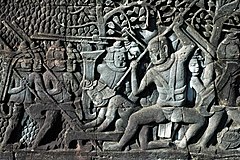 Having roamed around for a bit we left the temple precinct and rode on looking at the spacious city and its embelishments.We view the gallery of elephants,below the bas-relief on wall shows elephants in procession.Observe the details.
Next we reach Ta Prohm.The so-called 'Tomb Raider Temple' after all Lara Croft: Tomb Raider was shot here on location.This temple is cloaked in shadow,its crumbling towers and walls locked in the slow muscular embrace of vast tree roots.We are informed that Ta Prohm has been restored aesthetically by the Archaeological Society of India and IIT Madras.Hearteningly, the giant roots of trees have been retained.
Above is the famous ‘Tomb Raider tree’,where Lara Croft.. ahem...Angelina Jolie picked a jasmine flower before falling through the earth into…Pinewood Studios.
 Undoubtedly Ta Prohm's appeal lies in the fact that unlike the other monuments of Angkor,it has been swallowed by the jungle.Ta Prohm is a temple of towers,closed courtyards and narrow corridors.Many of them are impassable,clogged with jumbled piles of carved stone blocks dislodged by the roots of long-decayed trees.
We pushed our way in,curious to investigate and found ourselves in very dark corridors where cell phones were our saviours providing much needed light to tread those uneven paths. Some pictures were taken and I present those here.The one on bottom right which has been more or less cosumed by the tree trunk was hard to spot.
I have zoomed in on it from a distance
 |
A carved stone block
still standing |
After this amazing experience we go for lunch at a nearby restaurant which served good fish,rice and coconut water!
Next, Angkor Wat in proper light....
We are at once struck by its imposing grandeur and at close quarters its fascinating decorative flourishes.It is a very impressive sight indeed...Wah Taj! Wah A'Wat!
The plan of Angkor Wat is difficult to grasp when walking through the monument because of the vastness.From a distance it appears to be a colossal mass of stone on one level with a long causeway leading to the center but close up it is a series of elevated towers, covered galleries,porches and courtyards on different levels linked by stairways. Stretching around the outside of the central temple complex is a long series of intricate and astonishing bas-reliefs – carvings depicting Hindu mythology in great detail.There is the Kurukshetra war,Ramayana events and plenty of Shiva,Vishnu,Yama,Ravana representations.It will take half a day to cover and appreciate the intricate carvings and their meaning.We see the Ocean churning scene,this time in bas relief.

 Apsaras are everwhere here true to their role in Hindu mythology.Columns surrounding the courtyards were ornamented with hundreds of statues of graceful apsaras,with elaborate jewellery and hair ornaments.And you can see a mutitude of them flanking/crowding Indira in heaven who is hovering above Vishnu in the pic above.As you cannot see them clearly,here they are carved on stone and some in colourful cardboard cut outs...Beautiful aren't they.
 Many of us climbed up the narrow stairway and walked around the outer gallery of the upper level to enjoy the view of the surrounding countryside,the causeway in the west and the central group of towers.We also saw shrines inside that were dedicated to Buddha who must have replaced Vishnu.

Soon we are at ground level having spent considerable time walking the long pathways and corridors and climbing those stairways, listening to our guide extolling the virtues and valour of the Varman Kings ...of an edifice whose mightiness and magnificance surpassed that of the Pharaohs and how the french explorers discovered the ruins and gave new life to it.
A long walk brought us back to our Van and we were on our way back to Siem Reap for a much needed shower and rest.
I leave you with this beautiful vintage sketch drawn by Louis Delaporte the French explorer and archaeologist who uncovered Angkor in 1863
Edit
Pointers:Edi
- Angkor is hot and sticky throughout the year, but the peak season is November to February,when the weather is dry and temperatures are coolest (25-30°C). March to May is hot,with temperatures reaching 40°C. June to October is the rainy season,and outlying temples and the roads leading to them can turn into quagmires of mud. However, this is also when the temples are at their quietest, and it's still often possible to do a good half-day round of sightseeing before the rains start in the afternoon.
- The best time of day is sunrise when it’s cooler but crowded, or lunchtime when most of the tour groups are in town.
- Plan at least three hours to explore the whole complex,but more like half a day if you want to explore every nook and cranny.Another half day for Angkor Thom,Bayon and Tah Prohm
- Angkor Wat opens at 5am for visitors who want to see the sunrise. The upper level is only open from 7.30am. Angkor Wat closes at 5.30pm.
- Entry pass to the temples of Angkor costs USD 37 pp for a day...as of Oct 2017
_________________________________________________
Day 3
We have seen the back of the guide as also the Van which will now come only to transport us back to the airport.The Sun was hot as we stepped out after a liesurely breakfast and decided to visit the local market and hopped into a TukTuk - a spacious auto rickshaw which can seat 4-6 people. It was a Lexus! it is a very comfortable means for sightseeing at a phenomenal economy.
After minor shopping and cooling off we returned to the hotel and eventually made our way to the airport to catch our return flights; ours via Bangkok to Mumbai.
That was indeed like a tryst with ancient Indian history!
___________________________________________________________


 The erstwhile King of Nepal also had a grand house built on a crag in another direction.Lot more impressive than the President house.
 Naresh pointed out the trees planted here viz., Apricot,Plum and Apples all looking barren now,but for some Apricot flowers in bloom.


 The temple priest attends once a week;all other days and times one is free to open the doors,pray and leave.Very clean and quiet.We sat there enjoying the silence but for the bark of Sheru the dog who was enjoying his time with a couple of monkeys on the tree. Sheru followed us most of the way back.

 We were 10 adults and a child and were taken to a small village where our farmer host Sharma was waiting with folded hands.They are Bramins left over from an regime of kings whose temple they were managing. When the king migrated he offered land and homes to these families. Some still survive like the Sharma family who literally laid the red carpet for us..The 2-3 Hrs we spent with them was not only educative but an afternoon well spent in the cool of a small farm surrounded by hills,discussing organic farm practice,cash crops and fruits they grow.

 There was tea and home made snacks followed by a delicious lunch after the tour,where a local delicacy,Sidu was the show stopper.To compare... this looks like a Momo in shape ,a liittle larger,but made out of wheat and delicious veggie stuffing inside.It was served with Desi Ghee,Dal,and a special green chutney made of green peas,green chilies, groundnuts and chopped paneer other than Dania and Pudhina. The simple preperation and fresh taste of it all took us to another level and we asked for more servings.
 Ravi,our soft spoken taxi driver,took us on this drive and set us down next to a guy who pushed a visiting card at my face and said he would organise a horse ride for us through the heavily wooded hills blah..blah..There were a spattering of tourists on horse backs and we too joined the ride past the HP tourism cottages and began climbing the rickety pathway holding on to the camera tightly.There was a photo session at a clearing known to have hosted Bollywood for their song and dance,over the years.Path was full of ridges as we moved on looking at the old Tibet road skirting the hills yonder and going towards China.Then came the highlight of the gallop.


